

Fixing the recruitment funnel, from homepage to first year.
Where good candidates are lost before and after they join, and the practical steps that keep them moving: the homepage, the wait in the middle, the first 30 days and the first year.
A GUIDE FOR FIRE, EMS AND LAW ENFORCEMENT
Most losses are quiet
Agencies tend to look for recruitment problems in two places: not enough people applying, or new members not staying. Both can be real. But many agencies also lose people in places they never measure: on the homepage, in the wait between applying and the first drill or shift, and in the first weeks after joining. These losses are quiet. Nobody files a note saying they felt ignored. They stop replying, stop showing up, and the seat is empty months later. This guide follows a candidate from first visit to the end of year one. For each stage: what to ask, what a good answer sounds like, and what to look at more closely.
THE STAGES
Where candidates are lost, and what to do about it
1 OF 8
The homepage
A visitor decides within seconds whether this agency is worth their time. If the way to join is hard to find, many leave without telling you.
A visible path to join
A clear link or button such as “Join our team” sits in the main navigation, not inside an administration dropdown.
Every entry point leads somewhere
People arrive from the homepage, a job posting, a social link or a search. Each one should lead to the same obvious next step.
One plain statement of the next step
Say what to do, who to contact and what happens after.
External systems named plainly
If applications run through a civil service, county or state portal, say so and link straight to it.
Before you start
You do not need to turn the whole homepage into a recruitment billboard. The goal is to make the path obvious for the visitors who are already considering joining. Local government sites compete for the same local talent. The same rule applies to dispatch, public works and other openings.
2 OF 8
The reason to serve
Ask: Does the recruitment page explain why the work matters and what joining involves, before it asks for an application?
- A good answerA short, honest account of the role in the community, in current members’ own words. It states the training required, the schedule and what it takes to stay in good standing.
- Look closer ifThe page is a generic equal opportunity statement or a list of benefits with no context, or the real commitment is left out to make the pitch sound easier.
3 OF 8
Photos and proof
Ask: Do the photos show your actual people, doing the actual work, in your actual community?
- A good answerReal members of different ages, backgrounds and roles, so a visitor can picture working alongside them. Photos match the agency, including its real apparatus and facilities.
- Look closer ifStock images of an unmarked engine or a generic office. They tell a visitor nothing about who they would serve with.
4 OF 8
The application on a phone
Ask: Can someone complete the full path on a phone, from the homepage link to a submitted application?
- A good answerThe form works on a small screen, saves or recovers if interrupted, and never requires printing a PDF. Staff have tried the whole sequence themselves, start to finish.
- Look closer ifDownloads, timeouts or awkward steps. Many candidates look around on a break or late in the evening, and each barrier is a reason to give up.
TALK TO US
Want a second opinion on your own situation?
Tell us a little about your department and we will talk it through, whether or not we end up working together.
5 OF 8
The wait in the middle
Between submitting interest and the first drill or shift sits the least glamorous part of the funnel: processing, checks, interviews, orientation and approvals. Interest fades while candidates wait.
One named owner per candidate
A specific person, not a committee, owns each prospect from first contact to first drill or shift. Handoffs are explicit.
A defined response window
Every inquiry gets an acknowledgment within a set time, such as the same or next business day, saying what happens next.
A published sequence
Every step between interest and first day is written down, in order, with a rough timeline, and given to every candidate.
Check-ins during gaps
A short message during a slow stage, even when nothing is needed from the candidate, keeps them engaged.
Before you start
Slow and confusing look the same from the candidate’s side. Someone who does not know whose move it is will stop reaching out. Silence is usually read as lack of interest, even when the agency fully intends to follow up.
6 OF 8
Background checks and approvals
Ask: Do candidates know how long background checks, medical clearance and approvals usually take, and why?
- A good answerThe timeline is explained in writing at the start, with updates during the wait. The steps are not skipped or rushed. They are explained.
- Look closer ifCandidates hear nothing for weeks. A long, silent wait can lead them to assume they are being screened out or forgotten, and some stop responding before the process finishes.
7 OF 8
The first 30 days
The first month is often when a new member decides whether they belong. Early excitement meets logistics, unfamiliar routines and a room of people who already know each other.
A named contact before day one
One person, introduced by name and phone number, before the first training night.
A first night built around inclusion
Introductions, a tour and something small to do alongside another member. Evaluation can wait.
An early, real win
A task scaled to their training that they can point to, such as supervised equipment use or a first ride-along.
A check-in about the person
At about two weeks and again at 30 days, ask how it is going and whether anything is confusing, not just whether the gear order arrived.
Delays explained quickly
Gear, paperwork and scheduling delays are told to the new member directly. A known delay reads as normal; an unexplained one reads as being forgotten.
Before you start
Existing members often do not see how confusing the place looks from outside: the acronyms, the seating, the unwritten rules. Good culture does not extend itself to the newest person. It has to be passed on on purpose.
8 OF 8
The first year
Ask: Who owns each new member for the full first year, and what happens if that person is away?
- A good answerOne named person, ideally not the recruiter, owns the relationship for twelve months, with a backup. A mentor is assigned, not implied. Many departments check in around two weeks, 30 days, 90 days and six months; pick points that fit your cycle.
- Look closer ifRecruitment ends at approval and nobody picks up the handoff. “Ask anyone, we are all friendly” stands in for a mentor. Early assignments are busywork or nothing at all.
A QUICK CHECKLIST
A recruitment funnel checklist.
Walk through it with your recruiting and training officers.
The way to join is in the main navigation, one click from the homepage.
The recruitment page explains why the work matters and what is expected.
Training, schedule and standing requirements are stated honestly.
Photos show your real members and your real community.
The full application works on a phone, with no printing required.
Any outside portal is named and linked directly.
Every inquiry gets an acknowledgment within a defined window.
One named person owns each candidate from first contact to first drill or shift.
The steps and rough timelines between interest and first day are written down and shared.
Candidates get a short update during every slow stage.
Every new member has a named contact before day one and a mentor afterward.
The first night includes introductions and something real to do.
Check-ins are scheduled at points that fit the department’s cycle (many departments use about two weeks, 30 days, 90 days and six months).
Time spent in each processing stage is tracked, not just applications received.
RELATED
Related
Feature pages, other guides and posts that go with this one.
WHERE WE STAND
What this looks like in practice.
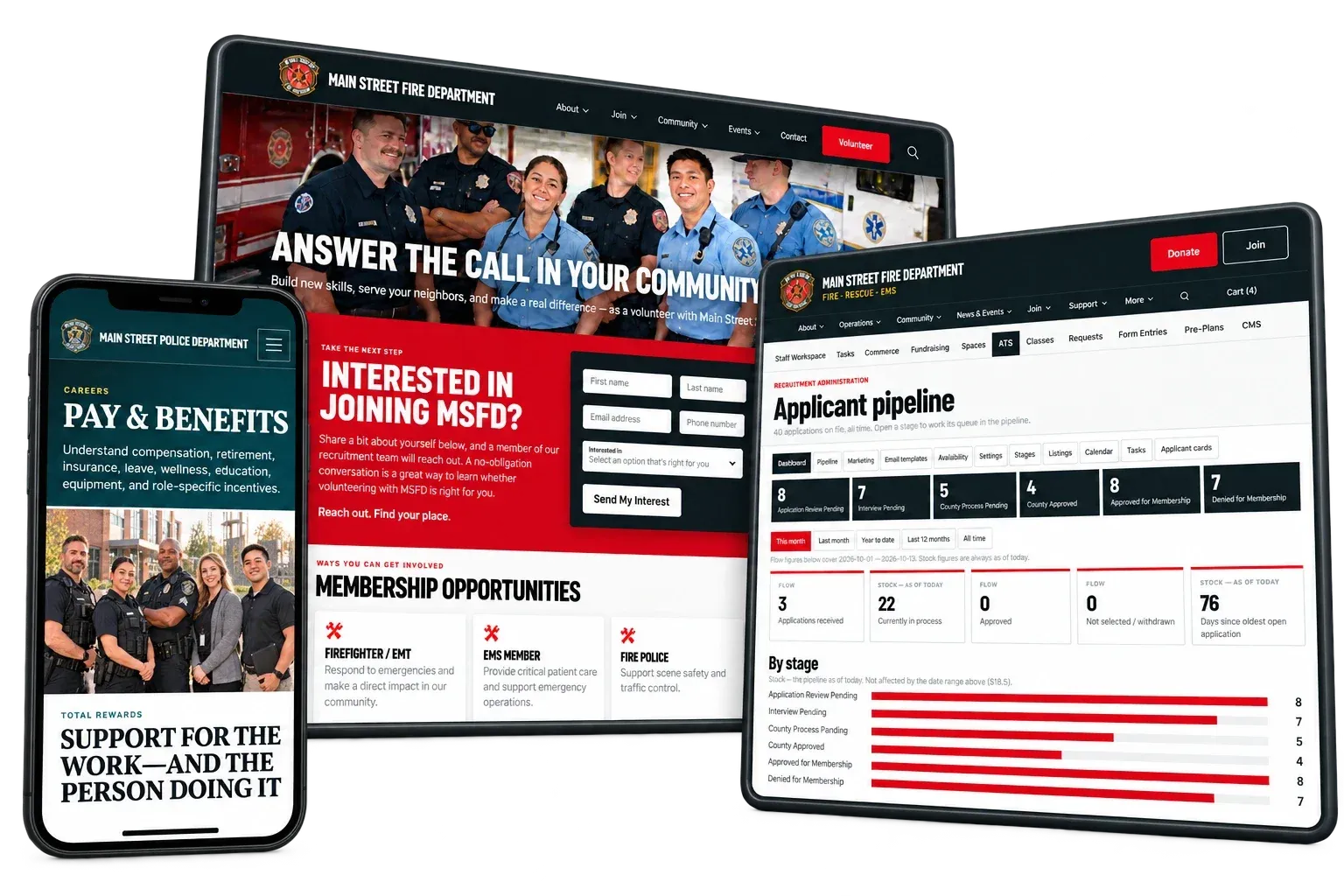
We build recruiting pages, applicant tracking and analytics, plus membership tools, for fire, EMS and law enforcement agencies. Here is where to read more.
Last updated October 2026
A note
This guide is general information, not legal advice. Background checks, medical questions, civil service rules and applicant data retention are governed by law and local policy and vary by jurisdiction. Confirm your process with your department’s attorney or HR advisor.
Questions about any of this?
We are happy to talk it through, whether or not we end up working together.
Contact us