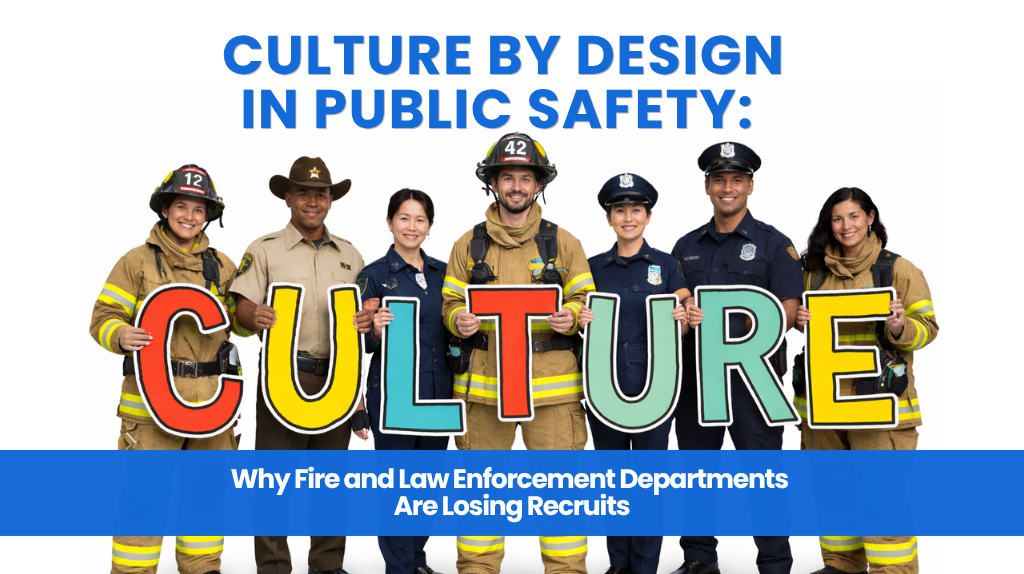
What culture really looks like during recruitment and why most organizations get it wrong
Culture gets talked about a lot in the public safety world.
You see it everywhere. On websites, on social media, in “we’re hiring” posts. Every fire department, police department, and EMS agency claims to have a strong culture. “We’re like family.” “We take care of our people.” “We hold a high standard.”
But here’s the problem.
Most public safety organizations aren’t building culture. They’re assuming it exists. And that assumption is costing them people, before those individuals ever walk through the door.
I recently read an article by John Velez on FirefighterNation.com titled “Culture by Design”, and it reinforced something I see every day working with fire departments, police departments, EMS agencies, and volunteer firefighters across the country.
Culture is either built by design or formed by default.
The reality is that many public safety organizations are operating by default. Not because they don’t care, but because no one has clearly defined what the standard actually looks like day-to-day, how it shows up in real interactions, and who is responsible for maintaining it.
So culture drifts. Not overnight. Not because of one bad firefighter or one difficult officer. It drifts in small ways that go unchecked. A missed follow-up. An inconsistent message. A first visit that feels awkward instead of welcoming. Over time, those small moments become the standard.
There’s a line in the article that hits hard: “You become what you allow.” That applies far beyond behavior inside the station. It applies directly to recruitment.

If your fire department or police department allows slow follow-up, unclear communication, or a lack of ownership in the recruitment process, that becomes your culture. Not the mission statement on the wall. Not the values listed on your website. Your actual culture is what people experience when they interact with you.
And that’s where most leaders miss it.
Your recruitment process is your culture on display.
People don’t join organizations because of what you say about yourself. They join based on what it feels like to engage with you. That experience starts long before they ever fill out an application. It starts when they land on your website, submit their interest, and wait to see if anyone responds.
That first interaction tells them everything. Is this organized or chaotic? Do people care or not? Is this something I want to be part of? You don’t get months to show your culture. You get a few minutes, maybe one interaction, to make it clear.
Velez talks about leadership setting the tone, and he’s right. Culture rises and falls on leadership. But it’s not just about holding people accountable or modeling behavior. Leadership sets culture through the systems and processes they allow to exist.
If you say you’re professional, but your follow-up is inconsistent, that sends a message. If you say you take care of your people, but your onboarding process is confusing or unclear, that sends a message. If you say you hold a high standard, but no one owns recruitment, that sends a message.
People believe what they experience, not what they’re told.
Another point that stands out is that culture is built in the mundane. It’s built in the small, everyday decisions that don’t feel significant in the moment. That absolutely includes recruitment. The speed of your response, the way you greet someone walking in, how clearly you explain expectations, and how your members talk about the organization all shape how your culture is perceived.
This is especially important for volunteer firefighters, where the decision to join often comes down to how someone feels in those early interactions. If the experience is unclear, slow, or impersonal, they move on. Not because they don’t care, but because nothing pulled them in.
One of the biggest gaps I see across public safety organizations is this: members are expected to recruit, but they’ve never been trained to do it. They don’t know what to say, how to start a conversation, or how to move someone from interest to action. So they default to vague responses and general encouragement, and the opportunity fades.
Over time, that becomes the norm. Not because anyone intended it, but because it was allowed.
If you want to improve recruitment, you have to improve the experience people have when they interact with your organization. That doesn’t require a complete overhaul, but it does require clarity and consistency. It requires defining what your standards actually look like in action, not just in words. It requires taking an honest look at your first impression and asking whether it reflects who you believe you are. It requires preparing your members to represent the organization clearly, confidently, and consistently. And it requires ownership, because without it, even the best intentions fall apart.
A strong culture doesn’t just retain members. It attracts them. But only if people can actually feel it.
You can’t market your way out of a broken process. You can’t message your way out of inconsistency. And you can’t expect growth if your culture is left to form on its own.
Culture is not what you say. It’s what you repeatedly do.
And every interaction is either building it or breaking it.
By Walter Campbell
Recruitment and Retention Strategist
The culture you want doesn’t happen by accident. Neither does recruitment.
If your fire department, police department, or EMS agency is ready to turn intention into action, email [email protected] and let’s build it the right way.